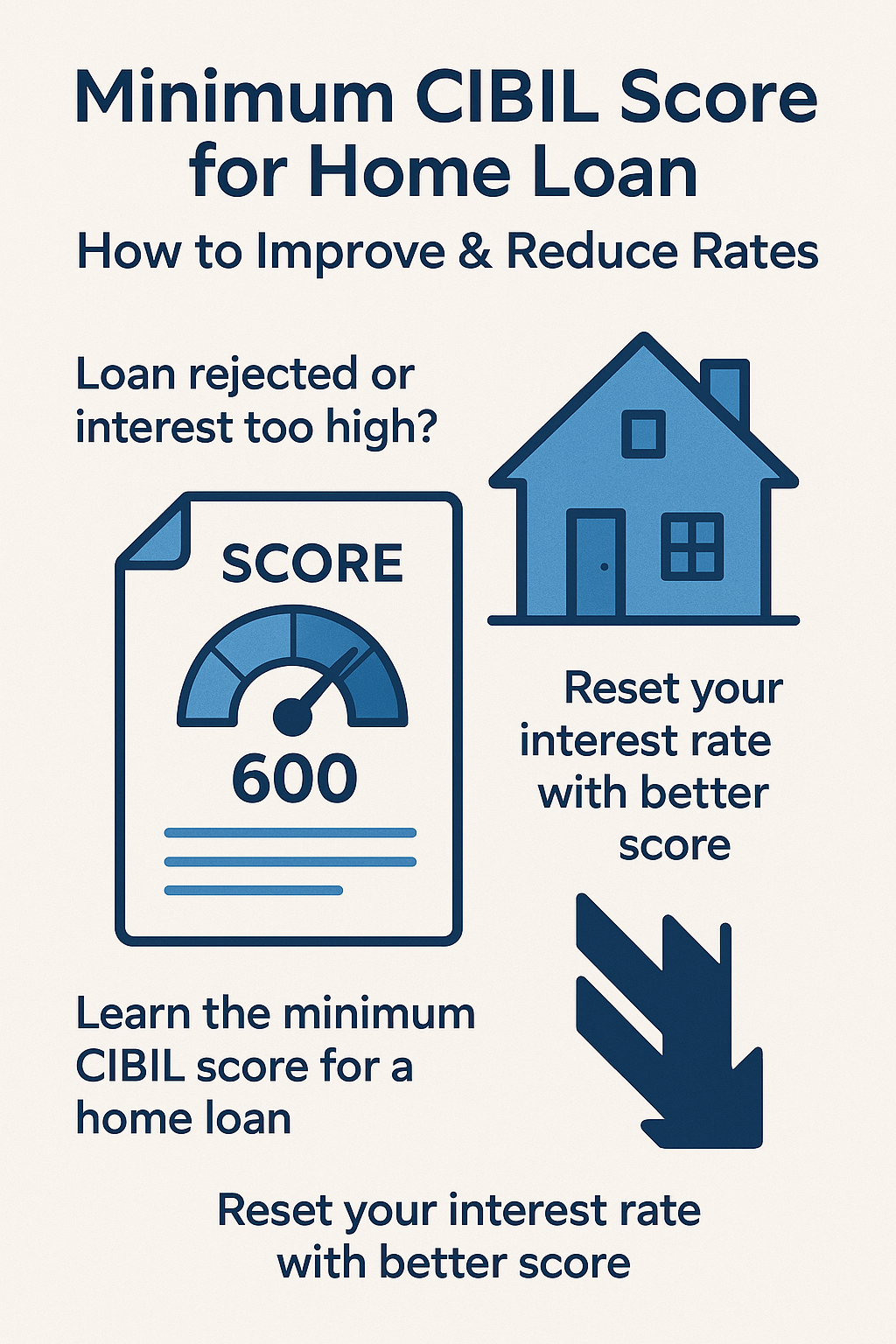
The 3-Digit Number That Decides Your Home Loan: CIBIL Score Explained
You have saved for the down payment. You have selected the property. You have submitted your documents to the bank.
Then, the rejection email comes. Or worse, the bank approves the loan but offers you an interest rate much higher than what you saw in the ads.
The culprit? Your CIBIL Score.
In the world of home loans, your credit score is your financial character certificate. It tells the bank one simple thing: If we lend this person money, will they pay it back?
Here is everything you need to know about the minimum CIBIL score required for a home loan and how to use it to negotiate a better deal.
1. What is the Magic Number?
The CIBIL score ranges from 300 to 900. While every bank has its own internal policy, the industry standards are consistent:
- 750 and above: This is the Gold Standard. Most top-tier banks (like SBI, HDFC, ICICI) require a score of 750+ to offer you their lowest advertised interest rates.
- 650 to 749: You will likely get the loan, but you are in the "Risk Zone." Banks may charge you a risk premium (typically 0.10% to 0.50% higher than the standard rate).
- Below 650: High chance of rejection. If approved, it will likely be at a steep interest rate from Non-Banking Financial Companies (NBFCs) rather than major banks.
2. Why Does the Score Matter? (The Interest Rate Link)
Years ago, the CIBIL score only decided "Yes" or "No." Today, under the Repo Linked Lending Rate (RLLR) regime, it decides "How much."
Your interest rate is calculated as: Repo Rate + Spread. * The Repo Rate is fixed by the RBI. * The Spread is decided by the bank based on your risk profile (CIBIL Score).
| CIBIL Score | Interest Rate Impact | | :--- | :--- | | 750 - 900 | Lowest Base Rate (Standard Spread) | | 700 - 749 | +0.25% to 0.35% Higher Spread | | 650 - 699 | +0.50% to 0.75% Higher Spread | | < 650 | Rejected or punitive rates |
The Cost of a Low Score: On a ₹50 Lakh loan for 20 years, a mere 0.50% difference in interest rate can cost you approximately ₹3.5 Lakhs to ₹4 Lakhs in extra interest over the loan tenure.
3. The "Reset" Secret: Lowering Your EMI Later
Many borrowers don't know this: Your interest rate spread is not permanent.
If you take a loan with a score of 720 (paying a higher rate) and improve your score to 760 after a year, you can approach your bank to renegotiate the spread. * Most banks allow you to switch to a lower risk bracket for a nominal "conversion fee." * This simple request can save you lakhs in future interest without needing to transfer your loan to a new bank.
4. What Damages Your CIBIL Score?
It is rarely one big mistake; it is usually small habits.
- Late Payments: Even a single delay on a credit card bill or an existing EMI can drop your score by 30-50 points.
- High Credit Utilization: If your credit card limit is ₹1 Lakh and you constantly use ₹90,000, you look "credit hungry." Aim to keep utilization below 30%.
- Too Many Loan Inquiries: Every time you apply for a loan (or a credit card), the bank fetches your report. This is a "Hard Enquiry." If you apply to 5 banks in one week, you look desperate, and your score drops.
- "Settled" Accounts: If you negotiated with a bank to pay less than what was due to close a past loan, it is marked as "Settled," not "Closed." This is a major red flag for future lenders.
5. How to Improve Your Score (The 6-Month Plan)
If your score is low (e.g., 680), do not apply for a home loan immediately. Take 6 months to fix it:
- Step 1: Check your CIBIL report for errors. Sometimes, a closed loan still shows as "active" due to a bank reporting error. Raise a dispute on the CIBIL website to fix it.
- Step 2: Pay off outstanding credit card dues in full (avoid paying just the "minimum due").
- Step 3: Stop applying for new credit cards or personal loans.
- Step 4: Ensure your credit mix is balanced. A mix of secured loans (like a car loan) and unsecured loans (credit cards) is healthier than having only unsecured debt.
6. What if I Have No Credit History? (Score of -1 or NH)
If you have never taken a loan or used a credit card, your score will be -1 or NH (No History). * Is this bad? No, but it makes banks cautious because they have no track record to judge. * The Fix: Get a basic lifetime-free credit card or a small consumer durable loan (e.g., for a phone) and pay it off regularly for 6-8 months before applying for a home loan. This builds a "track record."
Conclusion: Check Before You Apply
Before you fall in love with a house, check your financial health. A score of 750+ is your ticket to a hassle-free loan approval and the cheapest EMI.
Do not let a forgotten credit card bill cost you your dream home.
Check your home loan eligibility and connect with verified banking partners through GharPe Loans. For more tips on managing your property finances, read our Finance Blog at https://gharpe.com.