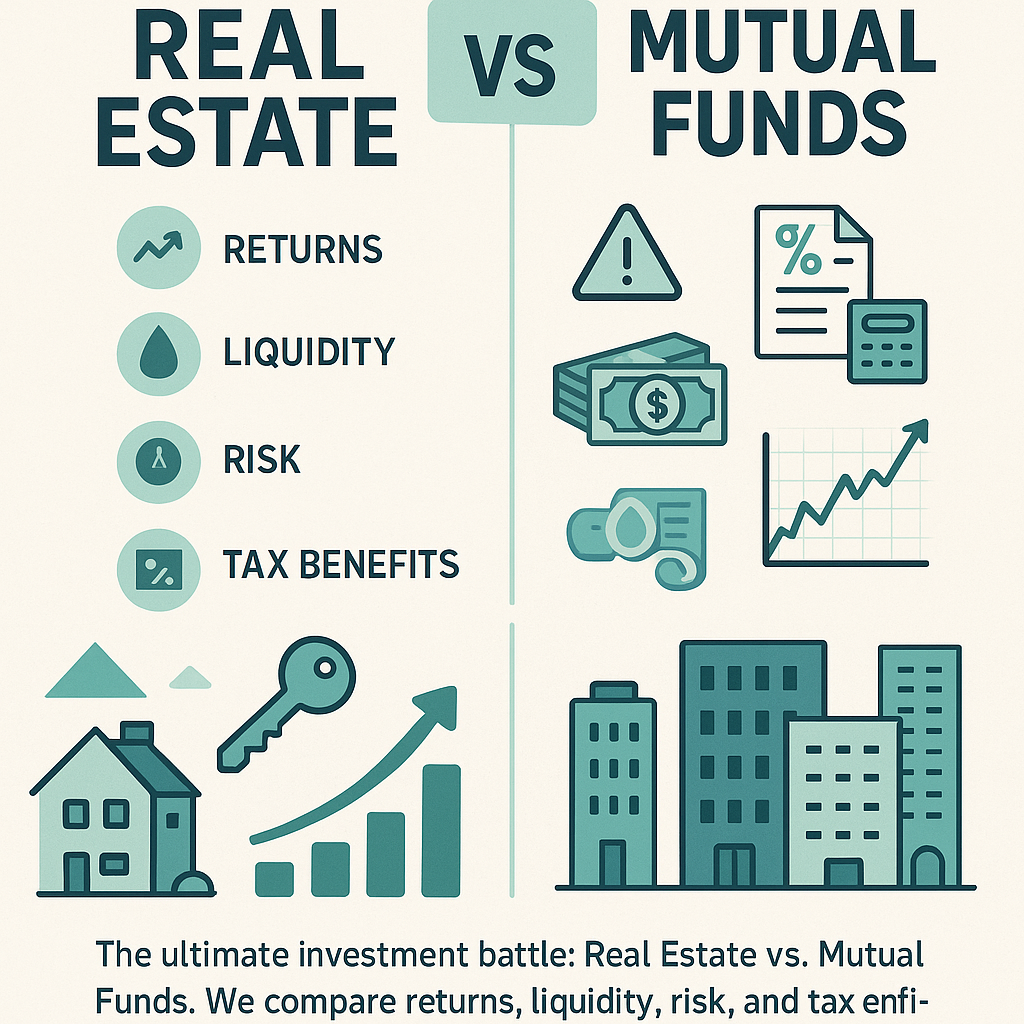
Real Estate vs. Mutual Funds: Where Should You Invest in 2026?
In every Indian family, there is an ongoing debate. The older generation swears by Real Estate—"land never loses value," they say. The younger generation, armed with financial apps, champions Mutual Funds (SIPs)—"compound interest is the eighth wonder of the world."
So, who is right?
If you have ₹50 Lakhs (or even ₹10,000 a month) to invest in 2026, where should it go? Should you pay an EMI to build a tangible asset, or start an SIP to build a liquid portfolio?
The answer isn't about which is "better"; it is about which is better for you. This guide strips away the emotion and compares these two giants of wealth creation on pure financial logic.
1. The Entry Barrier: Lakhs vs. Hundreds
This is the first filter.
- Real Estate: It is a "lumpy" investment. You need a massive upfront capital (down payment) of at least ₹10-20 Lakhs, plus eligibility for a home loan. You cannot buy "half a bedroom" if you run out of money.
- Mutual Funds: You can start with as little as ₹500. It is highly democratic. You don't need a loan to start, and you can increase or decrease your investment amount every month based on your salary.
Winner: Mutual Funds (for accessibility).
2. Returns: Stability vs. Velocity
How fast will your money grow?
- Real Estate: Historically in India, residential real estate has delivered returns of 7% to 10% annually (capital appreciation). However, this varies wildly by location. A stagnant market can give 0% returns for years.
- Mutual Funds: Equity Mutual Funds have historically delivered 12% to 15% annualized returns over the long term (10+ years). The power of compounding makes a massive difference here.
The Math: ₹1 Lakh invested in Real Estate at 8% becomes ₹4.6 Lakhs in 20 years. In Mutual Funds at 12%, it becomes ₹9.6 Lakhs.
Winner: Mutual Funds (for pure wealth multiplication).
3. Leverage: The "OPM" Advantage
This is where Real Estate strikes back. It is the only asset class that allows you to build wealth using Other People's Money (OPM)—the bank's money.
- The Scenario: You have ₹10 Lakhs.
- In Mutual Funds: You invest ₹10 Lakhs. If it grows 10%, you make ₹1 Lakh.
- In Real Estate: You use that ₹10 Lakhs as a down payment to buy a ₹50 Lakh property (taking a ₹40 Lakh loan). If the property price rises 10%, your asset grows by ₹5 Lakhs. You made a 50% return on your initial capital (₹5 Lakh gain on ₹10 Lakh investment).
Winner: Real Estate (the power of leverage).
4. Liquidity: Cash in Days vs. Months
Can you turn your asset into cash in an emergency?
- Mutual Funds: Highly liquid. You can redeem your units with a single click and have the money in your bank account in 2-3 days.
- Real Estate: Highly illiquid. Selling a property takes months (or years). You have to find a buyer, negotiate, and handle paperwork. You cannot sell "just the kitchen" to pay for a medical emergency.
Winner: Mutual Funds (for financial safety).
5. Tax Benefits
- Real Estate: A tax-saving machine. You save tax on principal repayment (Section 80C) and interest payment (Section 24). Plus, you save on Capital Gains tax if you reinvest the profit into another property.
- Mutual Funds: You pay tax on gains. Long-Term Capital Gains (LTCG) above ₹1.25 Lakh are taxed at 12.5%. There are no deductions for investing (unless you pick ELSS funds, which have a lock-in).
Winner: Real Estate (for reducing your tax burden).
6. The "Sleep Well" Factor (Tangibility)
This is intangible but powerful. * Mutual Funds: They are digital entries. When the market crashes by 20% (like in 2020), your portfolio value drops overnight. This volatility causes panic. * Real Estate: It is a physical asset. Even if property prices dip, the building is still there. You can touch it, live in it, or rent it out. It provides a psychological sense of security that stocks never can.
Winner: Real Estate (for emotional security).
Conclusion: The Ideal Strategy
Don't treat this as an "Either/Or" choice. The smartest investors use both.
- Start with Mutual Funds: In your 20s, use SIPs to build your initial capital and down payment. Focus on high-growth equity funds.
- Move to Real Estate: In your 30s, once you have a stable income and a down payment, buy a property to anchor your portfolio and save tax.
- The Golden Ratio: Ideally, your portfolio should be 40% Real Estate (stable, leveraged) and 60% Financial Assets (liquid, high-growth).
To start your journey, compare verified properties for your real estate portfolio at GharPe Listings. For more financial planning tips, visit our Investment Blog at https://gharpe.com.